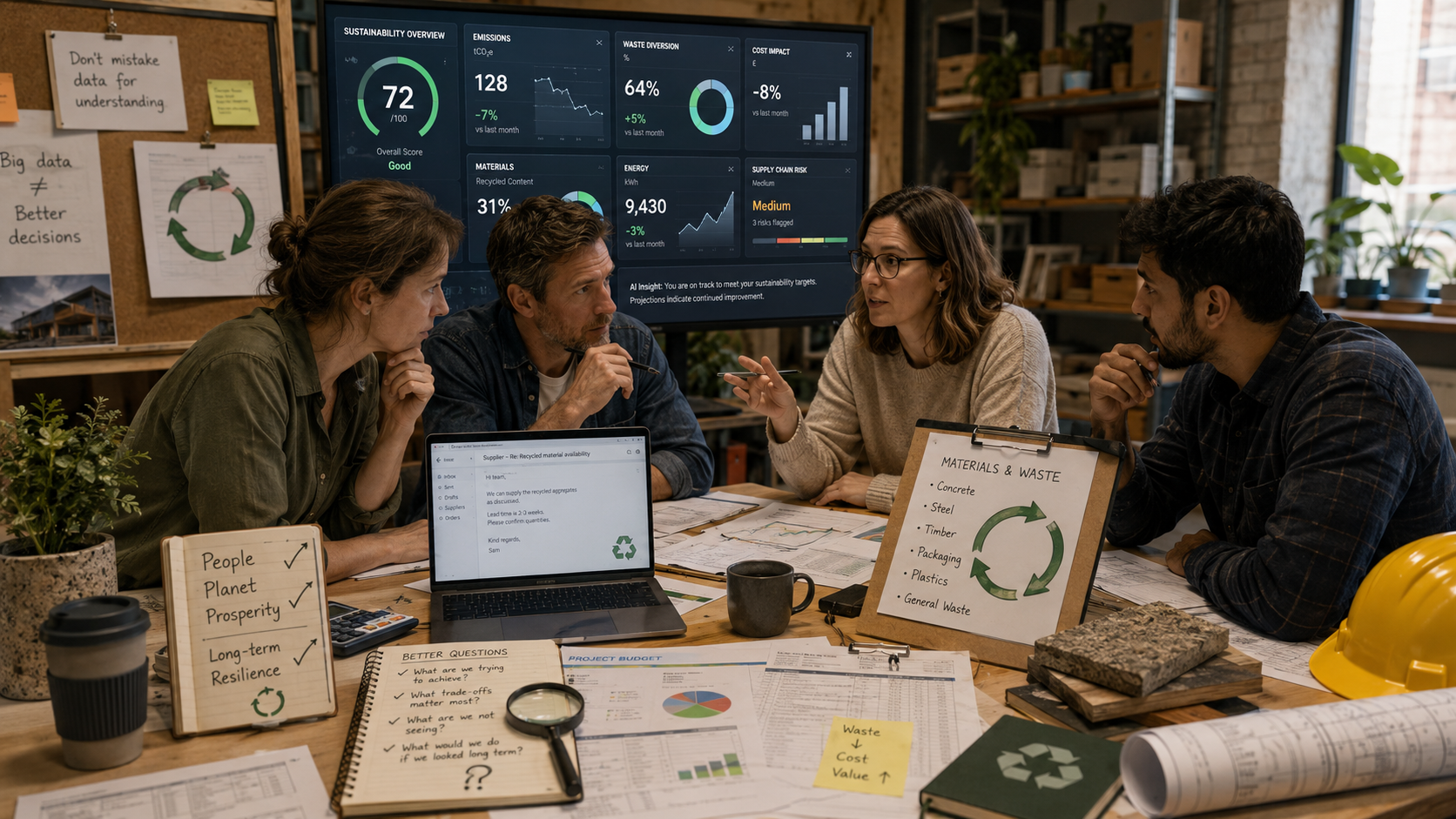
For many SMEs, sustainability is no longer a public relations issue – it is becoming part of everyday business survival. Customer expectations, supply chain demands and regulations are constantly changing, forcing smaller companies to keep adjusting how they work. Faced with this pressure and uncertainty, SME owners and managers often turn to technology for solutions: collecting more data, buying better software, building dashboards and using artificial intelligence to become more data-driven.
While this approach has obvious appeal, it also carries risks: more data does not automatically guarantee better decisions – sometimes it creates false confidence, especially when sleek dashboards become “comfort pictures” that make complex trade-offs look simpler than they really are and may help companies make poor decisions faster.
That is the problem behind what BusinessCloud recently called the “AI paradox”. In 2025, it reported that AI use was rising sharply in UK and US businesses, yet 26% of organisations had no formal data strategy, 39% had little or no data governance framework, and 57% said most employees lacked data literacy. In other words, many companies are adopting powerful tools before building the judgement, skills and routines needed to use them well.
For SMEs, this paradox is not simply about adopting AI prematurely, it is also about assuming that better decisions require more sophisticated data than the business already has. Smaller companies often operate with limited staff and rely on basic operational records, such as spreadsheets, invoices, supplier emails, waste logs and project budgets. Yet incomplete, inconsistent or untidy data is not necessarily useless: what matters is whether managers can question, interpret and act on the information already available to them.
Recent research by Elena Giovannoni and Paolo Quattrone argues that collecting more data cannot eliminate the unknowability at the heart of complex organisational decisions; instead, businesses need ways of keeping important questions open while still making practical choices. Earlier work by Quattrone, Cristiano Busco and colleagues for the Chartered Institute of Management Accountants (CIMA) shows that the pursuit of certainty can create blind spots because managers begin to focus only on what can be easily measured. Instead of producing reassuring but misleading answers, accounting reports should support better questioning. A good report should make trade-offs visible, order complex information without pretending to settle it, bring different views into the conversation, and create regular opportunities for scrutiny and debate. In other words, accounting should not work like an “answer machine” – it should help managers notice what is missing and question what is assumed before decisions are closed too quickly. That may sound unusual, since accounting is typically associated with control, accuracy and precise answers. But in areas such as sustainability, where regulations and expectations continue to change, accounting may be more valuable when it does not close the discussion too quickly.
To show how this works in practice, Quattrone, Busco and colleagues examined businesses across different sectors and countries. One of the best examples comes from Monnalisa, a medium-sized Italian fashion company, where a provisional budget, used to develop new clothing collections, did much more than record financial figures: it became a working space where designers, accountants, sales staff and production managers debated trade-offs between creativity, cost, production complexity, ethical considerations and customer expectations. Some figures were provisional, and some cells were empty, while issues such as supplier reliability, brand identity or customer value could not be fully captured. But that incompleteness made the budget useful: it forced people to talk, made assumptions visible and helped departments challenge each other before decisions were finalised.
The same principle can apply in smaller companies: SMEs do not need elaborate reporting systems, but they do need regular meetings where managers from different parts of the business can examine the same information and ask different questions of it. Those questions can surface tensions between cost and waste, speed and responsibility, short-term margins and long-term resilience.
There is also a cautionary tale. In the same CIMA report, a failed UK construction project showed what can happen when businesses rely too heavily on past decisions and assumed expertise instead of scrutinising data and asking basic but crucial questions. The former chief executive later reflected that someone should have asked: “Can we do this under the current project specification? Would it work?” But those questions were never asked. This shows that failure is not always caused by lack of information – sometimes it is caused by lack of doubt and data scrutiny.
This is especially relevant in the age of dashboards. A dashboard can help managers see a problem quickly, but it can also create what researchers Ronzani and Gatzweiler call the “lure of the visual”. Their study of a major UK infrastructure project showed that increasingly simplified and polished visual reports could make performance information appear clear and ready for action, while pushing aside the detail and discussion needed to understand what was really happening behind the scenes.
This is not an argument against technology. AI, dashboards and digital tools can help businesses process information faster and notice patterns they might otherwise miss. Recent research by Tiitola and colleagues suggests that digital management accounting can still support questioning, but only when AI-powered computation is balanced with human judgement and interaction. The danger comes when businesses treat digital outputs as final answers rather than prompts for discussion.
Ultimately, however, better questioning must also help businesses decide what to do next and act on it. Sustainability data may suggest several possible courses of action, but managers must still choose which opportunities to pursue. Strategic management scholar David Teece uses the term “dynamic capabilities” to describe a business ability to notice opportunities and threats, act on them, and reorganise resources and routines to support a chosen strategic direction. This ability is especially important in sustainability, where regulations, customer expectations and technological advancements continue to reshape the business environment.
Yet an important question remains: dynamic capabilities research explains why businesses need to adapt but says much less about how management accounting practices around incomplete or contested sustainability data help that capacity develop in SMEs. How do spreadsheets, budgets, dashboards and review meetings help managers move from debating uncertain information to choosing a course of action and then to changing organisational routines?
This missing link is the starting point for my doctoral research at Edinburgh Napier University. Focusing on UK construction SMEs, the study examines how management accounting practices help businesses keep sustainability information open to questioning while making it usable enough to guide decisions and action. It explores how repeated questioning, decision-making and adjustment may change accounting routines and help companies develop what I call Sustainability Data Dynamic Capabilities – the capacity to use sustainability data to recognise circular opportunities and threats, act on them, and adjust how data is collected, discussed and used as conditions change. The study does not simply ask whether SMEs should use technology; instead, it asks what happens after data appears on a screen, spreadsheet or report. Who discusses it, what assumptions are challenged, which trade-offs are simplified too quickly, and when provisional numbers become the basis for action.
The aim is not to tell SMEs to reject technology and big data, but rather to challenge the idea that better sustainability decisions come only from more data, bigger systems or faster automation. For many small companies, progress may begin with simpler but more disciplined questioning: what does our existing data keep showing us that we have stopped noticing? Which costs are signalling waste, delay or missed opportunity? Which circularity options are we rejecting too quickly because one number looks unfavourable? Whose experience is missing from the discussion?
Sustainability will not be achieved by dashboards alone, nor will circular economy opportunities appear just because a business collects more data. The businesses that adapt best may not be those with the biggest systems, but those that know how to turn messy information into better judgement and coordinated action.